Every year brings a long list of AI announcements. Most of them don’t change much for a company trying to get one useful system working.
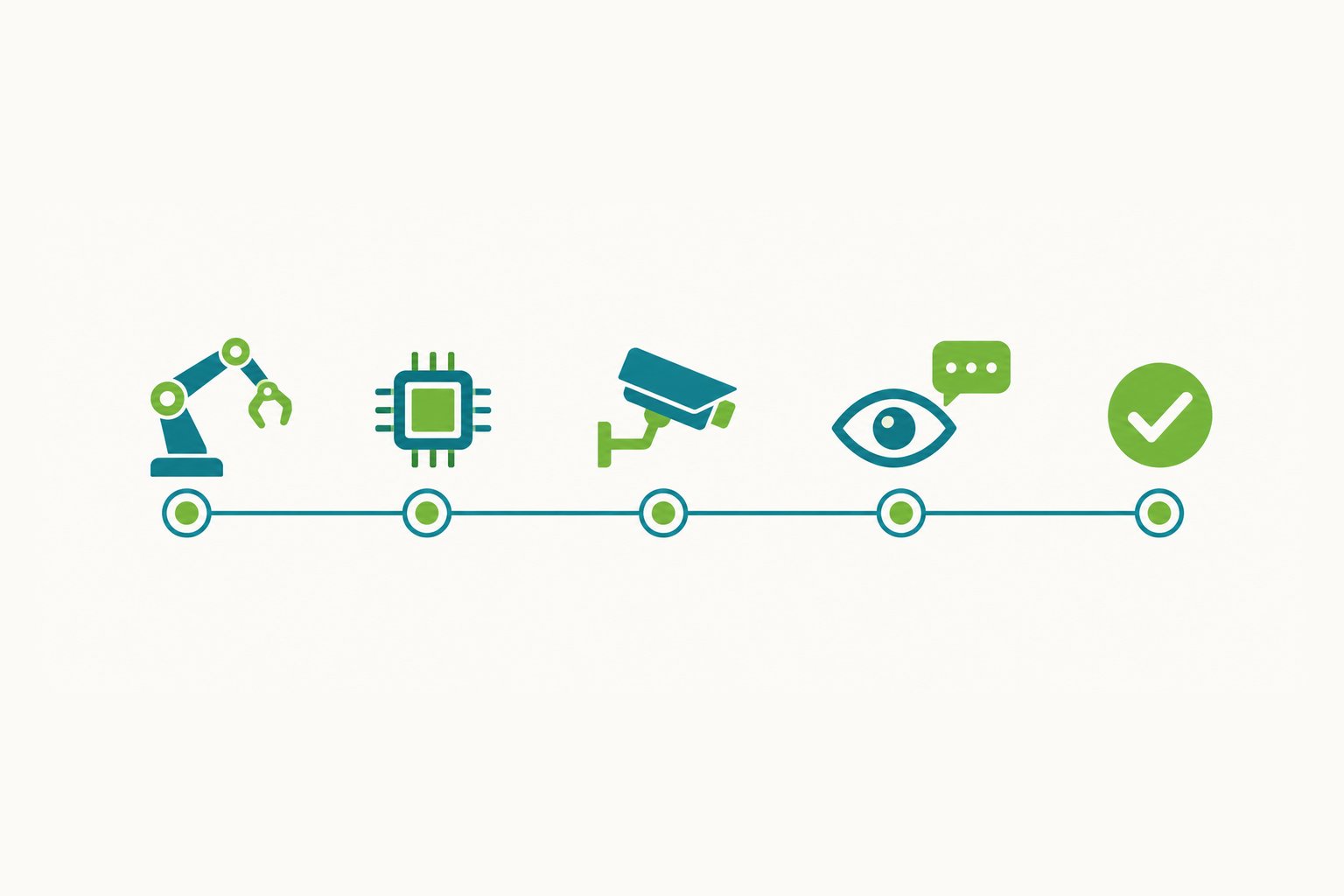
But some things did change this year, and we saw them in our own projects. Here are the five that matter most if you are planning AI work for 2027.
1. Agents moved from demos to real work
In 2025, most AI agents we saw were demos. In 2026, more of them started doing actual daily work: reading documents, checking figures, filling forms and raising questions when something looks wrong.
What made the difference was not smarter models. It was better design. On a port logistics project, we split the work into clear steps (extract, check, fill, ask, escalate) so every action is recorded. Anything that looks wrong stops for a person to review.
The lesson: give an agent a narrow job, clear rules and a human for the exceptions.
2. Smaller models got good enough
A year ago, many teams sent every task to the biggest model they could afford. Now smaller models handle a lot of everyday work well: sorting, extracting, summarising and simple reasoning.
That means lower costs, faster answers, and the option to run models on your own servers when data can’t leave the building. For many projects, the right question is no longer “which is the best model?” but “what is the smallest model that does this job well?”
3. More AI is running at the edge
More of our vision work now runs on devices at the site instead of in the cloud. Cameras produce a lot of video, and sending all of it to the cloud is slow and expensive. Some sites also have weak internet.
On a PPE safety project for Benchmark Data in Canada, we ran the models on hardware at the site itself, so detection doesn’t depend on a reliable connection. Edge devices are now powerful enough that this is often the simpler choice, not the harder one.
4. Vision models started to “read” video
Classic computer vision answers fixed questions, like “is there a helmet in this frame?” Vision-language models can describe a scene in plain words and answer questions about it.
They are not ready to replace trained detection models where speed and accuracy matter. But they are very useful next to them: reviewing flagged clips, searching hours of footage, or handling rare cases that a fixed model was never trained on.
5. Buyers started asking for proof
This may be the biggest change. Companies are still spending on AI. Upwork reported that work in AI-related categories grew more than 22% in its second quarter of 2026. But buyers are more careful now. They have seen pilots that never reached production.
So the questions have changed. Not “can AI do this?” but “how will we know it works on our data, what does it cost to run, and who looks after it after launch?” Good teams answer these before the build starts, with a short test on real data and a clear number.
What this means for your 2027 plans
If you are planning AI work for next year, a few simple rules follow from all this:
- Start with one narrow, useful job, not a big platform.
- Pick the smallest model that does the job well.
- Decide early where it will run: cloud, your servers or the edge.
- Test on your own data before you commit to the full build.
- Plan for monitoring and ownership from day one.
Planning an AI project for 2027? See how we start with a two-week discovery sprint, or let’s talk.