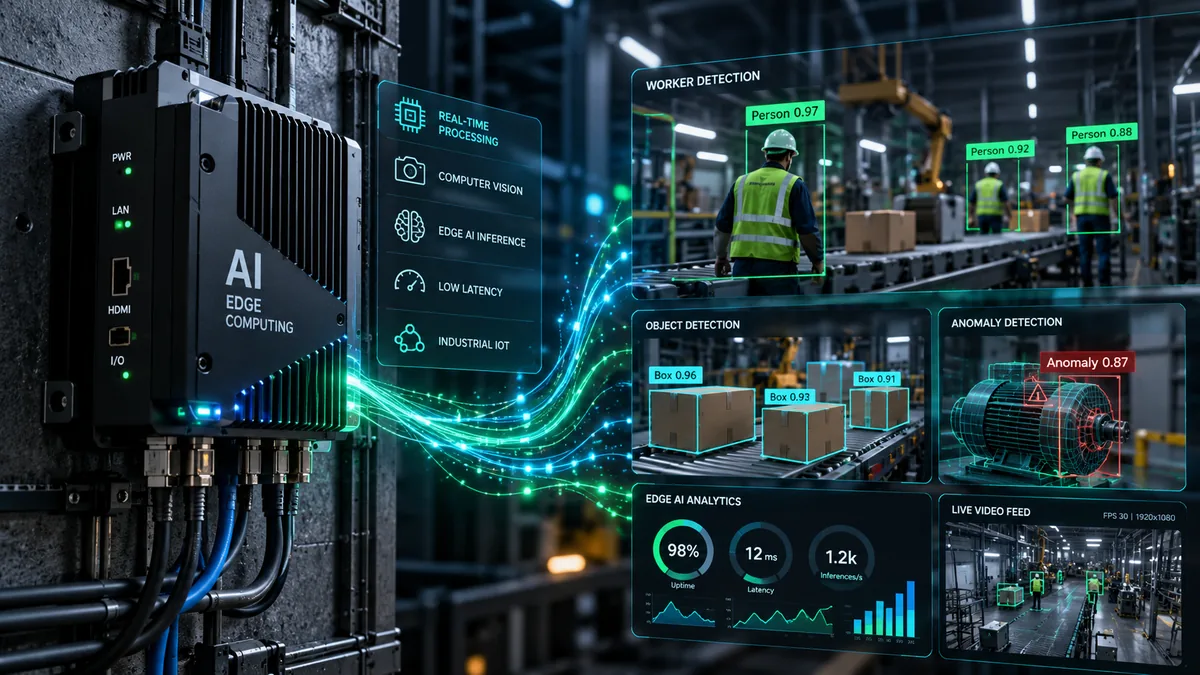
Deploying computer vision models in controlled cloud environments with boundless GPU memory is straightforward. Deploying them inside an industrial facility, waste sorting plant, or outdoor construction site is an entirely different engineering challenge.
On-site camera streams produce gigabytes of raw video per hour, network uplinks are frequently unstable or bandwidth-metered, and safety or sorting decisions must happen within milliseconds.
Here is how we engineer computer vision pipelines that run entirely on local edge hardware, hit strict latency targets, and remain resilient without relying on a persistent cloud connection.
1. The cloud-first bottleneck on live sites
Streaming 1080p RTSP camera feeds to a cloud server introduces three critical failure points:
- High and variable latency: Network hops and video encoding add 250ms to 800ms of latency, making real-time safety shutoffs or robotic sorting impossible.
- Prohibitive bandwidth costs: Streaming multiple 24/7 high-bitrate camera feeds exhausts on-site uplinks and incurs large egress and cloud ingress charges.
- Zero tolerance for network outages: If the internet connection drops, cloud-dependent safety checks or operations halt immediately.
The solution is to keep inference, tracking, and compliance logic entirely local on edge devices (such as NVIDIA Jetson Orin, Intel NPUs, or specialized edge accelerators), transmitting only lightweight event metadata and flagged frames to the central web portal.
2. Establishing a strict latency budget
To process a standard 30 FPS camera feed in real time without dropping frames, your entire end-to-end processing pipeline has a strict window of 33.3ms per frame:
| Pipeline Stage | Target Latency | Optimization Technique |
|---|---|---|
| Hardware Video Decoding | 3 - 5 ms | NVDEC / V4L2 hardware acceleration |
| Preprocessing & Normalization | 2 - 4 ms | Zero-copy GPU memory tensors, warp affine |
| Model Inference (INT8 / FP16) | 12 - 18 ms | TensorRT / ONNX Runtime engine execution |
| NMS & Multi-Object Tracking | 3 - 5 ms | Vectorized IoU matching (ByteTrack/Kalman) |
| Rules Engine & Local Event Log | 2 - 3 ms | Asynchronous queue to local SQLite/DuckDB |
| Total End-to-End Budget | < 30 ms | Real-time 30 FPS throughput achieved |
3. Model optimization: FP32 to FP16 and INT8 Quantization
Standard FP32 model weights are too memory-heavy and slow for edge accelerators. We optimize vision models into compiled runtime engines:
- FP16 Half-Precision: Provides an immediate ~2x speedup on modern Tensor Cores with virtually zero loss in detection accuracy (mAP).
- INT8 Post-Training Quantization (PTQ): Reduces weight memory footprint by ~4x and nearly doubles throughput. However, naive INT8 quantization can degrade detection of small objects or PPE in low-contrast lighting.
- Representative Calibration Datasets: To prevent accuracy cliffs, we calibrate INT8 activation ranges using 500+ curated frames captured directly from the deployment site across shift changes and lighting variations.
- Quantization-Aware Training (QAT): For ultra-critical small feature detection, we simulate INT8 precision during training so the network weights adapt prior to edge export.
4. Asynchronous pipeline architecture and ring buffers
A single synchronous loop (`while True: read -> infer -> write`) causes frame backpressure whenever inference spikes. We separate the edge application into isolated worker threads communicating via shared zero-copy ring buffers:
- Decoupled Capture Worker: Captures RTSP frames continuously into a circular memory buffer. If an inference worker takes longer on a crowded frame, incoming frames are buffered rather than dropped.
- Batched Inference Worker: Consumes pre-allocated GPU memory pointers directly, eliminating host-to-device (CPU-to-GPU) memory copy overhead.
- Graceful Frame Skipping: If sustained throughput drops below threshold, the pipeline intelligently drops intermediate visual frames while preserving the state of the tracking filter.
5. Multi-object tracking across partial occlusions
Frame-by-frame object detection alone is insufficient for industrial monitoring. Workers frequently cross paths, step behind machinery, or move out of the frame briefly.
We pair detection models with lightweight trackers (such as ByteTrack or SORT with Kalman filtering). By associating low-confidence bounding boxes in secondary matching stages, the system maintains persistent IDs across occlusions without running computationally expensive visual Re-ID models on every single frame.
6. Zero-uplink architecture: local queues and resilient sync
Edge deployments must operate autonomously when external connectivity goes down:
- Local Event Store: Detection events, bounding box coordinates, and compliance violations are written immediately to a lightweight local database (SQLite or DuckDB) on edge flash storage.
- Pre/Post Event Clip Buffer: The system retains a rolling 10-second video buffer in memory, saving compressed event snippets only when a violation or key event occurs.
- Resilient Background Sync: When network connectivity is restored, an asynchronous sync agent pushes queued events and compressed snapshots to the cloud platform using exponential backoff and batching.
7. Key takeaways for production edge vision
- Design for disconnection: Your system should be able to run unsupervised for days without an active internet connection.
- Calibrate with real site footage: Never calibrate INT8 engines on synthetic or public benchmark imagery.
- Own the full pipeline: True edge performance is achieved when video capture, tensor memory, inference, and tracking are architected as one unified stack.
Building an edge computer vision system for industrial or on-site deployment? Talk to our engineering team.