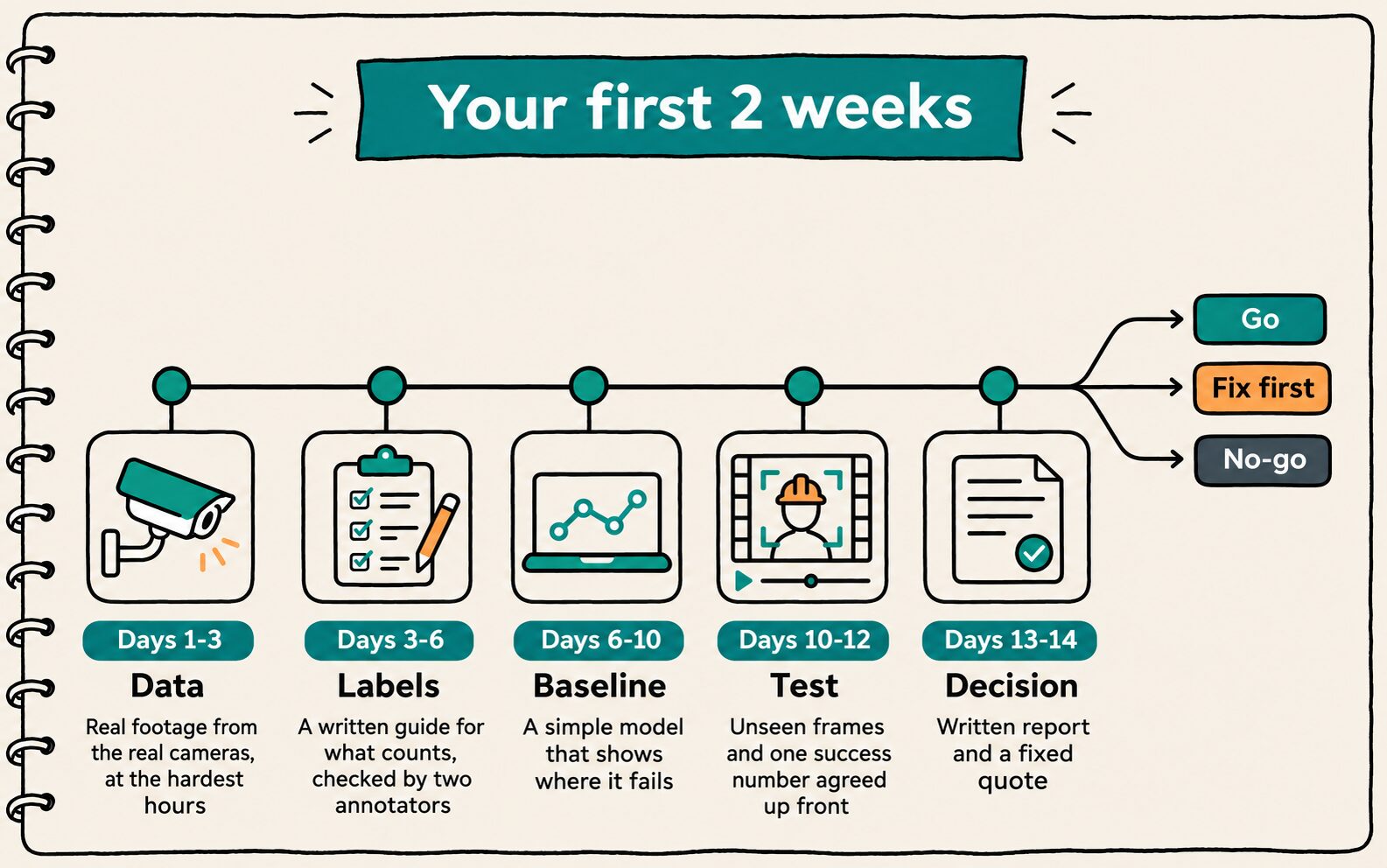
A lot of computer vision projects start the wrong way. A budget gets approved, a team starts building, and only months later does someone notice that the cameras never showed what the model needed to see.
Most of the risk is not in the model. It is in the footage and in the definitions. Those problems are cheap to find in the first week and expensive to find in month four. So we start small: two weeks to find out if the idea works on your data. This is how we do it.
1. Agree on what the model should do
Before anyone labels an image, we agree on a few things with the people who will use the system. What should the camera notice? What happens when it does: an alert, a report, or a person reviewing it? Will it run on a device at the site or in the cloud?
We also agree on one number that means success. For example, at least nine in ten violations caught, with no more than one false alarm per camera per hour. The right number depends on what a missed event or a false alarm costs you. What matters is that it is written down on day one, not chosen after the results come in.
2. Look at the footage you already have
The model has to learn from the cameras it will really use, at the hours it will really run. Clips from the internet, or footage filmed specially for the test, will make it look better than it is.
So we check the real recordings. Do they cover night shifts, midday glare and busy periods? Are the objects you care about big and clear enough in the frame? We also agree what must be blurred or kept on site before any footage is shared. This step often finds the first real issue, like a camera mounted too high. That is far cheaper to fix now than after training.
3. Write a labelling guide, then label a small set
A model can only be as consistent as its labels. Detecting people without helmets sounds clear until you meet the edge cases. Does a helmet held in a hand count? A worker on a break outside the marked zone? Someone half hidden behind a machine?
Each of these needs a written answer and an example image, in the client’s own rules. Then two people label the same small sample and compare. Where they disagree, the guide is not clear yet, so we fix it before labelling more. You do not need your whole archive. A few hundred well chosen frames from different cameras and hours are enough to start.
4. Train a first model and look at where it fails
Next we fine-tune a proven, off-the-shelf model on your labelled frames. It will not be perfect, and it does not need to be. We test it on frames it has never seen, including the hardest cameras and hours, and measure the number agreed in step 1.
The most useful result is not the overall score. It is where the model fails. Does it miss things at night? Struggle with small objects far from the camera? Confuse two kinds of equipment that look alike? Each answer points to a different fix: more data from certain hours, a camera moved closer, a clearer definition, or a stronger model.
5. Check the speed on the real hardware
A model that runs well on a laptop can be too slow on a small device at the site, such as an NVIDIA Jetson. If the system will run at the edge, we measure its speed on that device during the two weeks. It is a much better surprise to have now than at launch.
6. Decide: go, fix first, or stop
At the end of two weeks there are three honest answers. Go: the first model meets the target, or there is a clear path to it. Fix first: the idea works, but something has to change, such as a camera position or a class definition. Stop: the cameras or the data cannot support the goal.
A stop is not a failure. It is the cheapest way to learn that a project would not have worked. Whatever the answer, you get a written report with the results and where the model fails, and a fixed quote for the full build if it is a go. It is also how we avoid the problem we wrote about last week: pilots that never reach production.
Have footage and an idea but not sure if it will work? Tell us about it, or see how our 2-week Discovery sprint works.